
Did you miss the German royal wedding?
15 years ago

The official Twitter accounts of Ukraine and Russia had a spat about the historical origins of Anna of Kyiv in 2017 after Putin referred to her in a speech as 'Russian Ani'. Both Russians and Ukrainians claim this much-loved queen as their own, but Anna was not a queen in either country. Anna actually became the first queen of France when she married King Henry I.
Young and beautiful, Anna was one of the daughters of Yaroslav the 'Wise', the Grand Prince of Kyiv 958 -1074 A.D.) and his wife Irina. They were strong believers in education, even for girls, so their daughters all studied maths, astronomy and Latin. Anna spoke several languages, and Henry was 'enchanted by her accomplishments'.
Legend has it that when Henry came to see Anna after her father accepted his second proposal on her behalf, she said, 'I hope that you're the king of France,' when he kissed her! The couple arrived in Paris in May, 1051. Everyone wants to be in Paris in springtime, except ... Anna, who was extremely disappointed by the town after her cosmopolitan and advanced hometown. She found Paris muddy and dirty with sewage in the streets! It also shocked Anna that the people didn't even know about stoves, and their dwellings were filled with smoke. Education was sadly lacking - Anna set about improving this by making the French literate, and the people had 'appalling customs'. Apparently, they didn't wash, and Anna is thought to have started the custom of bathing. She considered the French to be 'barbaric'.
Unfortunately, Anna's marriage was reputedly unhappy, and Henry was often away extending his kingdom. Anna performed administrative duties, signing important documents, and playing a powerful role in governance while Henry was away.
Anna named her son, the heir to the throne, Philip, a Greek name new to the kingdom. Her other children were Robert, Hugh and Emma. When Henry died, Anna was only 28 and she had to continue in her administrative role and also give advice because her young son was only nine. She really acted as Regent. Pope Nicholas II praised Anna for 'fullfilling royal duties with enviable fervour and remarkable intelligence'. Anna found time for romance, however.
While staying at Senlis castle, she met Count Raoul de Crespy de Valois who was also walking in the forest. The couple soon fell in love, and the count kidnapped her, and married her. But he was already married, and his wife complained to Pope Alexander II who excommunicated him, and ordered them to live apart. However, they refused to do that. The couple travelled with Philip, and advised him on his royal duties.
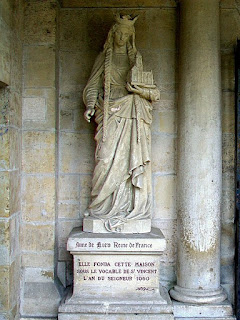
Anna founded the Royal Abbey of St Vincent of Senlis, probably to atone for her sins. She was a very pious woman so her unlawful marriage must have upset her. There is a statue of Anna placed there by the people of France who loved her very much. Now there is even a centre devoted to her, and to relations between Ukraine and France.
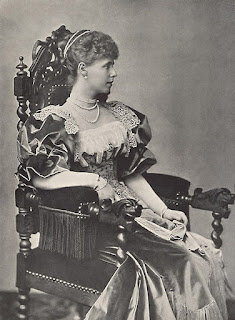
Stunned by Queen Marie of Romania’s golden-haired
beauty, graciousness and charming manner, the French author Colette wrote that
she ‘carried light within her’, after meeting her on the train when the Queen arrived in Paris. Queen Marie had travelled to Paris to meet the
leaders of the 1919 Peace Conference in Paris, hoping to persuade them to
honour the Treaty of 1916, and Romania’s territorial claims. Colette murmured
after interviewing Queen Marie: ‘Happy the city of Paris, Majesty, who can
welcome such a beautiful Queen,’ as she left Queen Marie’s train carriage.[i]
It has been a long hard road even for Queen Marie to
arrive at this point. Romania suffered great privation because of the
devastation of the Great War. Even the well-off struggled to survive, and famine
afflicted the country. ‘We are now burning dried corncobs, and files of old
newspapers in order to keep warm,’ the naval commander’s wife said. ‘We are
reduced to living principally on beans, and musty cornmeal porridge’.[ii]
Prime Minister Bratianu ordered Romanian troops to occupy Transylvania,
Bessarabia, Bukovina and the Dobruja, because he feared that the Allies would
not honour the Treaty of 1916, which gave Romania all these territories. He
wanted quick relief from the Allies. Unfortunately, the acquisition of these
lands only meant that Romania obtained several more millions to feed, and made
the country more susceptible to Communism, and revolution.
Warm-hearted, kindly Queen Marie, upset by the poverty stalking the country, visited destitute
villages after the Armistice with food, and clothing. Sometimes her young relation
Grand Duchess Marie joined her. She wrote that the pair often ‘came home long
after dark, cold and wet’.[iii]
Romania’s problem with wanting the secret Treaty of
1916 with the Allies honoured was that it had been forced to arrange a separate
peace with Germany. The PM also irritated the leaders of the conference by ‘playing
them off each other’.[iv]Bratianu’s demands fell on
deaf ears, and the Supreme Council rejected them. Also, Romania was only
allowed two delegates to the Council, when some other smaller countries had
three. The British PM, David Lloyd George asked: ‘Where the hell is that place
(Transylvania) and why is Romania so anxious to get it?’
Seeing the bleak prospects for Romania, the French
diplomat Saint Aulaire suggested that the Queen go to the conference, and the
King agreed that her warm personality might impress the leaders there. Queen Marie was extremely anxious about her
mission, but enthusiastic, and motivated to do her best. The Queen didn’t
know what she was in for!
Staying at the luxurious Paris Ritz, Queen Marie
impressed the French press who flocked to see her by offering to shake all
their hands! Her next ordeal was a meeting with French PM Clemenceau, ‘the
Tiger’. He immediately asked her about Romania’s agreement with Germany, and
Queen Marie explained that the Allies even ‘encircled Romania, and that the country was‘treated
like game’by both the Allies and the Entente. The fierce leader said that he liked her ‘speaking up’. When she
told him that Romania wanted the whole Banat as part of its claims, he said that ‘it’s the lion’s
share!’ Queen Marie said that that was why she came to ‘see his first cousin,
the Tiger’, and laughed.[v] Bratianu admitted that the
Queen had done more in a few days than he had in a month, or six weeks.
Queen Marie also visited England to make her case,
hoping to receive support from her old beau, King George V, who had once been very keen on her. She managed to
charm the press there as well, and Lord Curzon, acting Secretary of State for
Foreign Affairs held an official dinner for her, so that she could plead her
cause. Her old friend Winston Churchill was very sympathetic.
Back in France, she wanted to see President Wilson.
Unfortunately, she didn’t ‘hit it off’ with him on her first visit, shocking
him by talking about free love in Russia, but Mrs Wilson was impressed with her
charm, and invited her to lunch. The President berated the Queen about pogroms
in Romania, and she annoyed him by mentioning the ‘Negro’ and Japanese question
in the U.S. These two were never going to become good friends!
Romania doubled in size, becoming the fifth largest
country in Europe, largely due to the charming Queen’s efforts.

 Posts
All Comments
Posts
All Comments


