
Did you miss the German royal wedding?
15 years ago

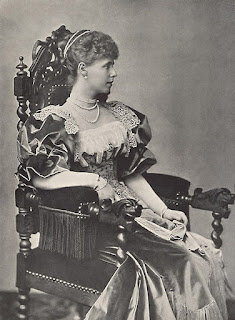
Stunned by Queen Marie of Romania’s golden-haired
beauty, graciousness and charming manner, the French author Colette wrote that
she ‘carried light within her’, after meeting her on the train when the Queen arrived in Paris. Queen Marie had travelled to Paris to meet the
leaders of the 1919 Peace Conference in Paris, hoping to persuade them to
honour the Treaty of 1916, and Romania’s territorial claims. Colette murmured
after interviewing Queen Marie: ‘Happy the city of Paris, Majesty, who can
welcome such a beautiful Queen,’ as she left Queen Marie’s train carriage.[i]
It has been a long hard road even for Queen Marie to
arrive at this point. Romania suffered great privation because of the
devastation of the Great War. Even the well-off struggled to survive, and famine
afflicted the country. ‘We are now burning dried corncobs, and files of old
newspapers in order to keep warm,’ the naval commander’s wife said. ‘We are
reduced to living principally on beans, and musty cornmeal porridge’.[ii]
Prime Minister Bratianu ordered Romanian troops to occupy Transylvania,
Bessarabia, Bukovina and the Dobruja, because he feared that the Allies would
not honour the Treaty of 1916, which gave Romania all these territories. He
wanted quick relief from the Allies. Unfortunately, the acquisition of these
lands only meant that Romania obtained several more millions to feed, and made
the country more susceptible to Communism, and revolution.
Warm-hearted, kindly Queen Marie, upset by the poverty stalking the country, visited destitute
villages after the Armistice with food, and clothing. Sometimes her young relation
Grand Duchess Marie joined her. She wrote that the pair often ‘came home long
after dark, cold and wet’.[iii]
Romania’s problem with wanting the secret Treaty of
1916 with the Allies honoured was that it had been forced to arrange a separate
peace with Germany. The PM also irritated the leaders of the conference by ‘playing
them off each other’.[iv]Bratianu’s demands fell on
deaf ears, and the Supreme Council rejected them. Also, Romania was only
allowed two delegates to the Council, when some other smaller countries had
three. The British PM, David Lloyd George asked: ‘Where the hell is that place
(Transylvania) and why is Romania so anxious to get it?’
Seeing the bleak prospects for Romania, the French
diplomat Saint Aulaire suggested that the Queen go to the conference, and the
King agreed that her warm personality might impress the leaders there. Queen Marie was extremely anxious about her
mission, but enthusiastic, and motivated to do her best. The Queen didn’t
know what she was in for!
Staying at the luxurious Paris Ritz, Queen Marie
impressed the French press who flocked to see her by offering to shake all
their hands! Her next ordeal was a meeting with French PM Clemenceau, ‘the
Tiger’. He immediately asked her about Romania’s agreement with Germany, and
Queen Marie explained that the Allies even ‘encircled Romania, and that the country was‘treated
like game’by both the Allies and the Entente. The fierce leader said that he liked her ‘speaking up’. When she
told him that Romania wanted the whole Banat as part of its claims, he said that ‘it’s the lion’s
share!’ Queen Marie said that that was why she came to ‘see his first cousin,
the Tiger’, and laughed.[v] Bratianu admitted that the
Queen had done more in a few days than he had in a month, or six weeks.
Queen Marie also visited England to make her case,
hoping to receive support from her old beau, King George V, who had once been very keen on her. She managed to
charm the press there as well, and Lord Curzon, acting Secretary of State for
Foreign Affairs held an official dinner for her, so that she could plead her
cause. Her old friend Winston Churchill was very sympathetic.
Back in France, she wanted to see President Wilson.
Unfortunately, she didn’t ‘hit it off’ with him on her first visit, shocking
him by talking about free love in Russia, but Mrs Wilson was impressed with her
charm, and invited her to lunch. The President berated the Queen about pogroms
in Romania, and she annoyed him by mentioning the ‘Negro’ and Japanese question
in the U.S. These two were never going to become good friends!
Romania doubled in size, becoming the fifth largest
country in Europe, largely due to the charming Queen’s efforts.

Was Edward IV’s
Marriage Valid?
The beautiful golden-haired widow pleading with him for the
return of her lands impressed the young King Edward IV. How brave she was to
talk to the King herself! Her family fought on the Lancastrian side in the
recent wars, the opposite side to him, but she dared to see him alone.
Edward soon fell in love with the lovely Elizabeth
Woodville, but legend has it that when he tried to seduce her she suddenly
threatened him with a knife, telling him that it was marriage or nothing.
Determined to have the young woman, Edward married her in secret in 1464, not
openly in the face of the church, as no banns were declared. There were rumours
that he had even hired a pretend priest, so that he could have his way with
Elizabeth, and that he’d done this before with other women!
However, Edward soon told his family about the marriage.
They were furious about an alliance with the ambitious Woodvilles, and regarded
Elizabeth’s status as too low for Edward. The Earl of Warwick, the powerful
‘Kingmaker’ was especially displeased when the King suddenly declared that he
couldn’t marry the French Princess Bona, because he was already married.
Princess Bona, the sister-in-law of Louis XI and the daughter of the Duke of
Savoy would have been a much more prestigious match for Edward than an English
widow with two sons already, even if she had an important mother, the Duchess
of Bedford. Elizabeth’s father was a middle-ranking knight. Edward’s brothers,
Richard and Clarence were ‘assuredly displeased’. The new Queen was not even a
virgin, and a politically important treaty with Louis XI which included the
arranged marriage with Princess Bona was ruined.
A Happy Marriage
Edward and Elizabeth were happily married for nineteen years,
although handsome Edward had several mistresses, and had ten children. However,
after Edward died suddenly in 1483, his brother Richard based his claim to the
throne on the marriage being invalid,
because of the secrecy concerning it, the lack of evidence of its
legitimacy, and because the King may have already had a pre-marital contract or
even been married to Lady Eleanor Butler, making his children illegitimate.
Eleanor, the daughter of the first Earl of Shrewsbury, was
also a young widow. She had been married to Sir Thomas Butler who died in
battle in 1461. According to the chronicler Comynes, Edward promised to marry
her after sleeping with her. He made this promise in front of Robert
Stillington, the Bishop of Bath and Wells. This was enough to be a pre-marital
contract, according to the decretals of Pope Alexander III.
The big flaw in this argument is that Eleanor came from a
powerful family, and neither she nor they protested about his marriage to
Elizabeth. Eleanor’s sister was the Duchess of Norfolk, and her mother was
Margaret Beauchamp, oldest daughter of the Earl of Warwick, so they could have
made a fuss.
The Bishop’s supporters presented a petition to Parliament,
later called the Titulus Regius,setting out the argument that the marriage
to Elizabeth was invalid, because of the pre-contract. The petition called this
marriage ‘ungracious’ and ‘pretensed’, even suggesting that it may have been
attained by the ‘sorcery’ and ‘witchcraft’ of Elizabeth and her mother,
Jacquetta. This enabled Richard to become King.
There are still questions about the legitimacy of the
marriage, even today, but as Edward made Elizabeth his Queen, and Eleanor’s
family didn’t protest his marriage to her, I think that it was very likely to
have been a valid match.


King Haakon VII made a dramatic speech to his people
from the inn in a small village near Elverum where he and Crown Prince Olav
were staying in April 1940. He said that he could not tell them where he, the
Crown Prince and the Government hid, for fear of attack by the German forces. He
told them that: ‘High explosive and incendiary bombs and machine-gun fire were
used against the civilian population and ourselves in the most unscrupulous and
brutal fashion’. The attack could only have one object, the King informed them –
to ‘annihilate all of us who were assembled to resolve questions in the best
interests of Norway’. He thanked all
those fighting for Norway’s ‘independence and liberty’, and to remember those
who had given their lives for the country. Finally, he parted with the moving
words: ‘God save Norway.’
Norway, a neutral country, watched hopelessly as much
of Europe fell to the Nazis like ten-pins, knowing that the Germans needed its
iron-ore for their munitions, so it was strategically important. Sweden was
also neutral, but Denmark soon fell to the Nazis, and the Danish King, King
Haakon’s brother, ceded to their demands. The dark days of Nazi occupation were
on the horizon. Luckily, the sinking of the heavy cruiser Blücher by the naval forces at Oscarbserg Fortress delayed
the German advance into Oslo, enabling the royal family and government to flee
capture.
The King, Crown Prince Olav and his family, and the
government had already made a dramatic escape from the Royal Palace in Oslo in
the early hours of April 8, after being told that the Germans were on their
way. They headed to Hamar on the train but hearing the explosions of bombs
falling nearby, they closed the curtains, lying on the floor in fear. Forced to
get off the train because of the German attack, they resumed their journey,
eventually reaching a tiny village near Elverum, where the King made his
broadcast.
A few days after they fled the royal family made the
sad decision to split up, considering the paramount importance of the young Prince
Harald (now King Harald V of Norway), the heir to the throne. Crown Princess Märtha and the children travelled to her
home country of neutral Sweden, and eventually went to America for the duration
of the war.
The King met with the
German envoy Curt Bräuer in Elverum, who pressured him to accept a new
government headed by Quisling, who had staged a coup d’état, and was friendly
with the Nazis. The King told him that he would ask his government to decide,
disgusted that he’d left the entire responsibility on his shoulders. Supported
by Prince Olav, the King threatened to abdicate if the government agreed to
having Quisling as their leader, but they sided with King Haakon. According to King
Haakon VII: The Man and the Monarch by Tim Greve, they were all deeply
moved.
Finally, escaping heavy bombing and the German
advance they arrived at Tromso where Sir Cecil Dormer sadly informed the King
about the withdrawal of Allied help, and the King and Crown Prince were
requested to go to Britain where they could help the Norwegian cause. The Crown
Prince offered to stay but he was strongly advised against it for fear of the
royal house falling into German hands. The King’s last words to his Cabinet
were: ‘God save our dear Fatherland’.
The
King and Prince Olav left for London on June 2, 1940 on the Devonshire.
Interestingly, the occupation government even requested his abdication in a
letter to England, which he adamantly refused.

 Posts
All Comments
Posts
All Comments


